Unfortunately, we missed the chance for a better scenario several years ago.
But hey – have a consolation prize.
A little chocolate to sweeten your naivety?
Take a look at a more realistic level.
Oh – you still believe in a perfect world?
Did you really think there was a better scenario?
You dreamer, you.
Unfortunately, we can’t turn back time.
The past is gone for good.
Can’t handle reality?
It’s okay – we’ve got something to help you.





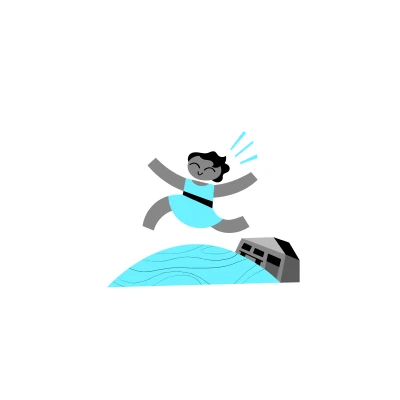
25 mm per hour or more than 35 mm within six hours: when very large amounts of rain fall in a short time, we call it heavy precipitation.
Such events have measurably increased in Switzerland and, depending on soil conditions, can lead to flooding or debris flows (large, avalanche-like landslides) in Alpine regions.
Switzerland is not used to the monsoon (yet...)!
-
Individual debris flows and landslides occur in particular where heavy rainfall has destabilised the ground. continue to Gravitational Natural Hazards
-
The warmer the atmosphere, the more water it can hold. This in turn increases the risk of heavy precipitation. Already today, the average amount of rain per rainfall event is rising. back to Climate Change
Heavy precipitation continues to increase significantly and affects regions very differently.
At higher elevations, extreme runoff and flooding may become less frequent in the second half of the century, with more water running off earlier in the year. At lower elevations, however, extreme runoff is increasing, raising flood risk.
-
In mountain regions, landslides and debris flows become more frequent, especially on steep and unstable slopes. They can also endanger settlements and roads. continue to Gravitational Natural Hazards
-
As air temperature and humidity rise, the risk of heavy precipitation also generally increases. back to Climate Change
Rainfall becomes less frequent. But when it comes, it often arrives as heavy downpours and frequently leads to flooding.
Dried-out soils (of which there will be more in future) cannot absorb water quickly enough. Instead, the water runs off the soil surface and into underground car parks, basements, or the main hall of Lausanne railway station.
-
Valleys and settlements can be cut off from the outside world by landslides and debris flows. continue to Gravitational Natural Hazards
-
The higher the air temperature, the more frequent intense rainfall becomes. Depending on the region, this may lead to catastrophic flooding. back to Climate Change
That's it. RIP.
That's a bit too much.
Maybe go down a level?
Got it – you're really into extremes.
Game over.
Try a different level.
That extreme? You’ll find the matching soundtrack here.
We’re done with this planet.
On to the next!




Solutionsfor: Heavy Precipitation
Asphalt doesn’t help.
So-called 'sponge cities' – with ample green spaces and permeable soils that allow water to seep away slowly rather than run off – are an effective way to reduce surface runoff and flooding. As a bonus, they also improve the urban climate.
But they require forward planning.
The rural equivalent is 'sponge landscapes': wetlands, natural and restored rivers, and forests that absorb and store water.
Early warning systems and information platforms such as www.naturgefahren.ch help in the short term – allowing people to prepare and get to safety in time.