Unfortunately, we missed the chance for a better scenario several years ago.
But hey – have a consolation prize.
A little chocolate to sweeten your naivety?
Take a look at a more realistic level.
Oh – you still believe in a perfect world?
Did you really think there was a better scenario?
You dreamer, you.
Unfortunately, we can’t turn back time.
The past is gone for good.
Can’t handle reality?
It’s okay – we’ve got something to help you.






Bark beetles don’t really deserve their bad reputation. In a stable ecosystem, they play an important role: breaking down weakened and dead trees to make room for regeneration. In addition to their work as forest recyclers, they also serve as food for other creatures.
However, following recent drought years – and especially after windthrow or snow-break events – bark beetles have spread so extensively in some regions that they are increasingly causing problems, primarily in already weakened spruce stands.
-
The development of bark beetles is directly linked to temperature. Whereas two generations per season used to be the norm, under today’s climate three generations are already possible. back to Heat
-
The spruce trees preferred by bark beetles are a key component of protection forests. continue to Loss of Protection Forests
-
Bark beetles infest trees that have become vulnerable due to heat and drought. This reduces their vitality and can lead to dieback. back to Tree Vitality
Bark beetles are spreading across many regions of Switzerland due to longer dry periods, particularly in the Swiss Plateau and at lower elevations within the spruce range. Near the treeline, bark beetle outbreaks are still infrequent, but the increasing number of reproductive cycles is causing spillover into higher elevations.
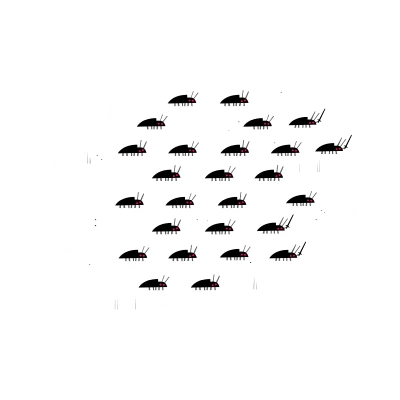
The number of generations per summer has increased from two to three. That translates into roughly three million additional beetles – and around 1,000 more infested trees.
-
Bark beetles thrive in warmth: one additional generation means millions more beetles. back to Heat
-
The spread of bark beetles reduces the effectiveness of spruce in protection forests. continue to Loss of Protection Forests
-
Bark beetles typically attack diseased or stressed trees, but in large numbers they can also damage healthy trees and cause dieback. back to Tree Vitality
If summer temperatures rise by 4°C, the number of bark beetle generations doubles. Bark beetles spread wherever spruce still grows.
After a few years, spruce trees largely die off – and bark beetle populations decline as well. They simply run out of food.
Infestation transforms the forest. Open habitats emerge, promoting the growth of herbs and pioneer tree species such as willow and birch, before later-successional species eventually take over. Hopefully, these are better adapted to the new climate... provided it has not already changed fundamentally once again.
-
Bark beetle populations increase exponentially – and so does the number of infested trees. back to Heat
-
Large-scale spruce tree dieback severely compromises protection forests. continue to Loss of Protection Forests
-
Widespread bark beetle outbreaks accelerate large-scale spruce mortality. The resulting deadwood also negatively affects the CO₂ balance. back to Tree Vitality
That's it. RIP.
That's a bit too much.
Maybe go down a level?
Got it – you're really into extremes.
Game over.
Try a different level.
That extreme? You’ll find the matching soundtrack here.
We’re done with this planet.
On to the next!





Solutionsfor: Bark Beetle
Diverse, structurally rich forests promote natural enemies such as predatory insects, fungi, tits, and woodpeckers. To reduce bark beetle populations, infested trees can be debarked or their trunks scored. The latter method is less harmful to the beetles’ natural antagonists.
In spring and summer, a four-week forecast of bark beetle development in Switzerland is available, along with a spatial model of their spread at a resolution of 2×2 km. If bark beetle outbreaks escalate, larger-scale salvage logging may have to be considered.
As forest services are already overstretched, priorities must be set strategically and based on objective risk assessments. The WSL Extremes Program's MountEx project is working on this.